Immersive Learning: Latin American Gardens Workshop
Growing Connections: Exploring Latin American Gardens Through Virtual Reality
The Consortium in Latin American and Caribbean Studies hosted Growing Connections: Exploring Latin American Gardens Through Virtual Reality, a hands-on professional development workshop at the FedEx Global Education Center at UNC–Chapel Hill. The session brought together educators, UNC students, and community members interested in exploring how emerging technologies can support meaningful, culturally grounded learning experiences.
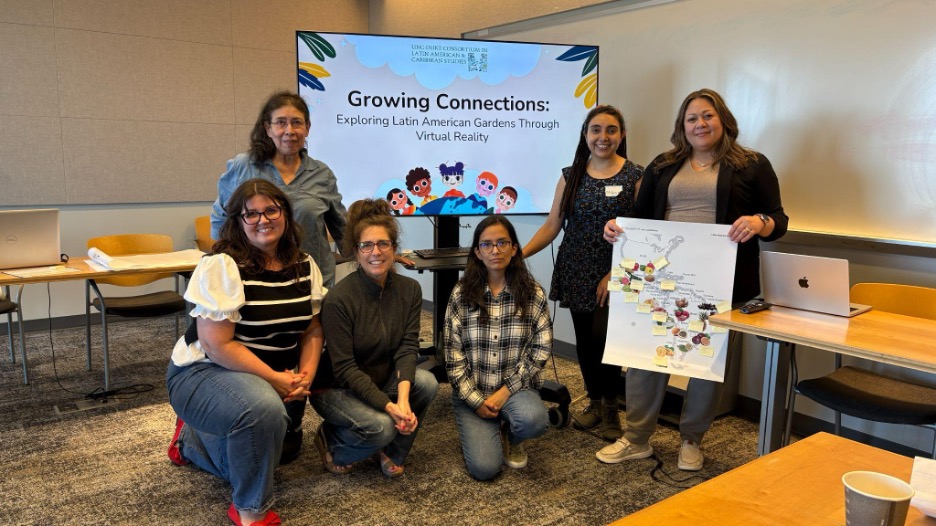
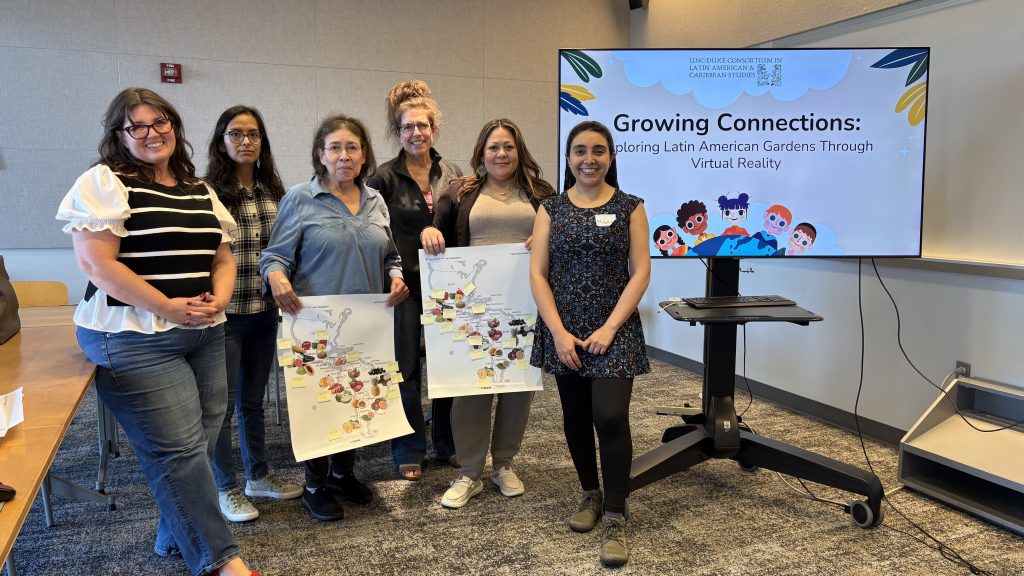
Participants in the Growing Connections: Exploring Latin American Gardens Through Virtual Reality workshop pose with a collaborative mapping activity highlighting Latin American fruits and vegetables.
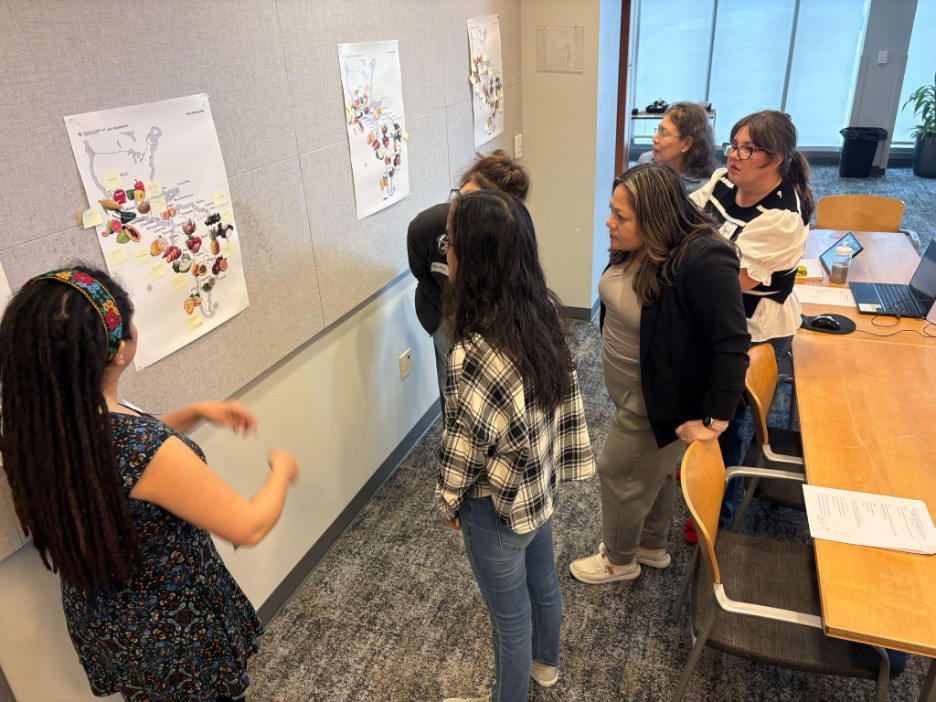
Participants engaged in a series of activities designed to connect immersive technology with Latin American cultural and ecological contexts. The workshop began with a collaborative activity in which participants identified fruits and vegetables by color and reflected on their origins across Latin America. Using a blank map, they worked individually and in groups to situate these foods geographically, drawing on prior knowledge and personal experiences. This opening activity set the stage for thinking about food not only as content, but as a cultural and pedagogical entry point.
Participants collaborate on a mapping activity, identifying the origins of Latin American fruits and vegetables using visual prompts and sticky notes.
The core of the workshop focused on immersive exploration and creation. Participants entered a bilingual virtual reality exhibition built in FrameVR, where they navigated a digital gallery featuring Latin American fruits and vegetables. Within this environment, they interacted with visual, textual, and three dimensional (3D) models representations designed to support both language learning and scientific understanding on fruits and vegetables from Latin America.
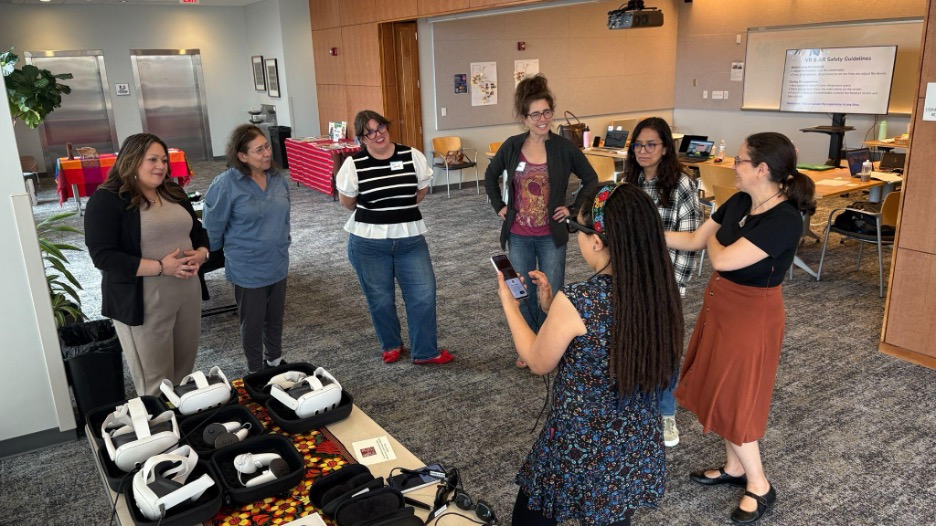
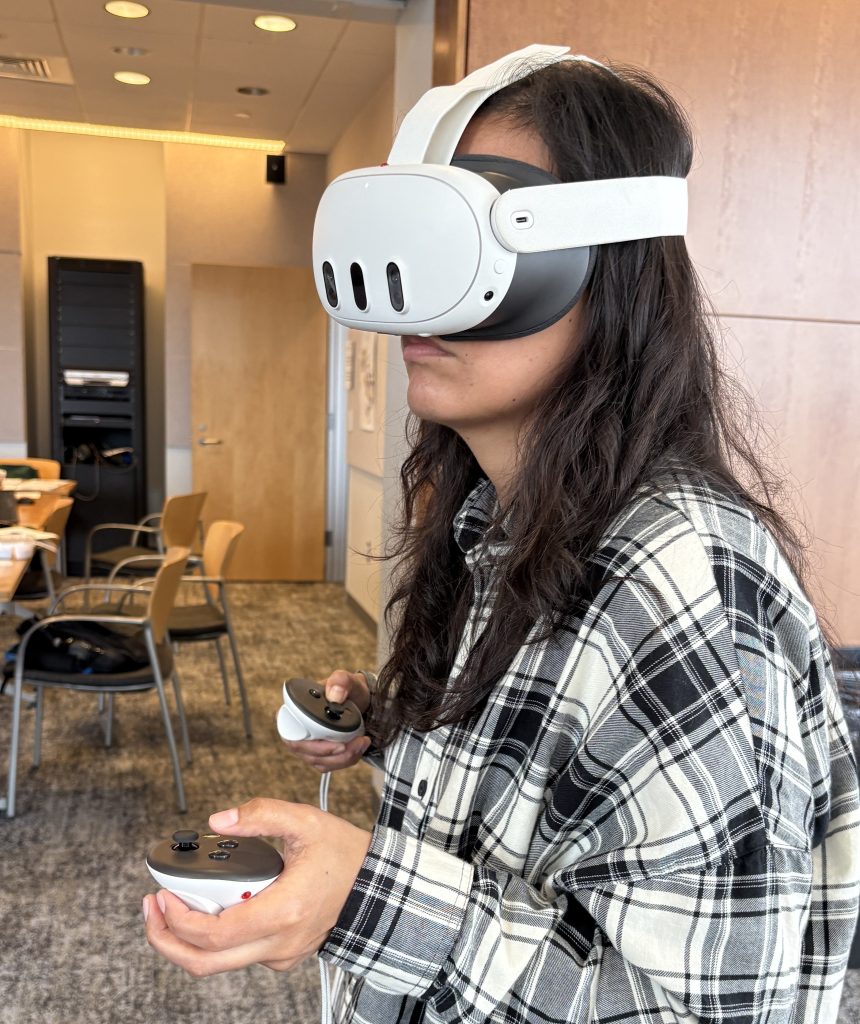
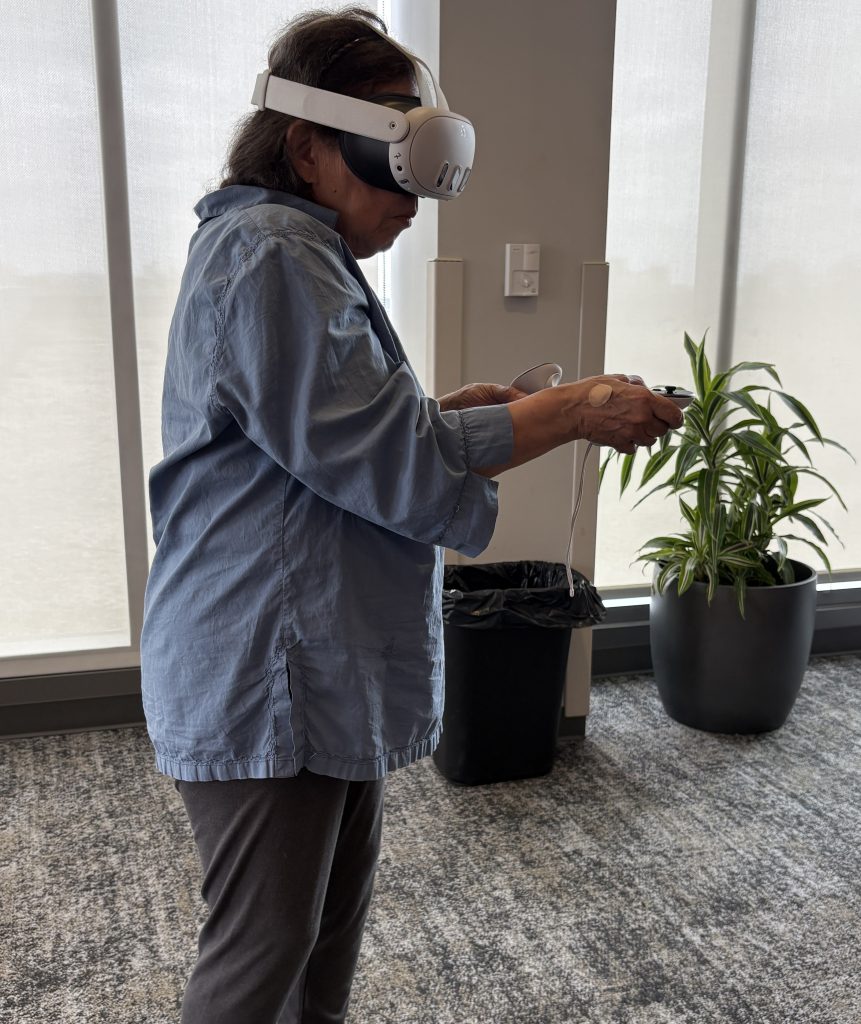
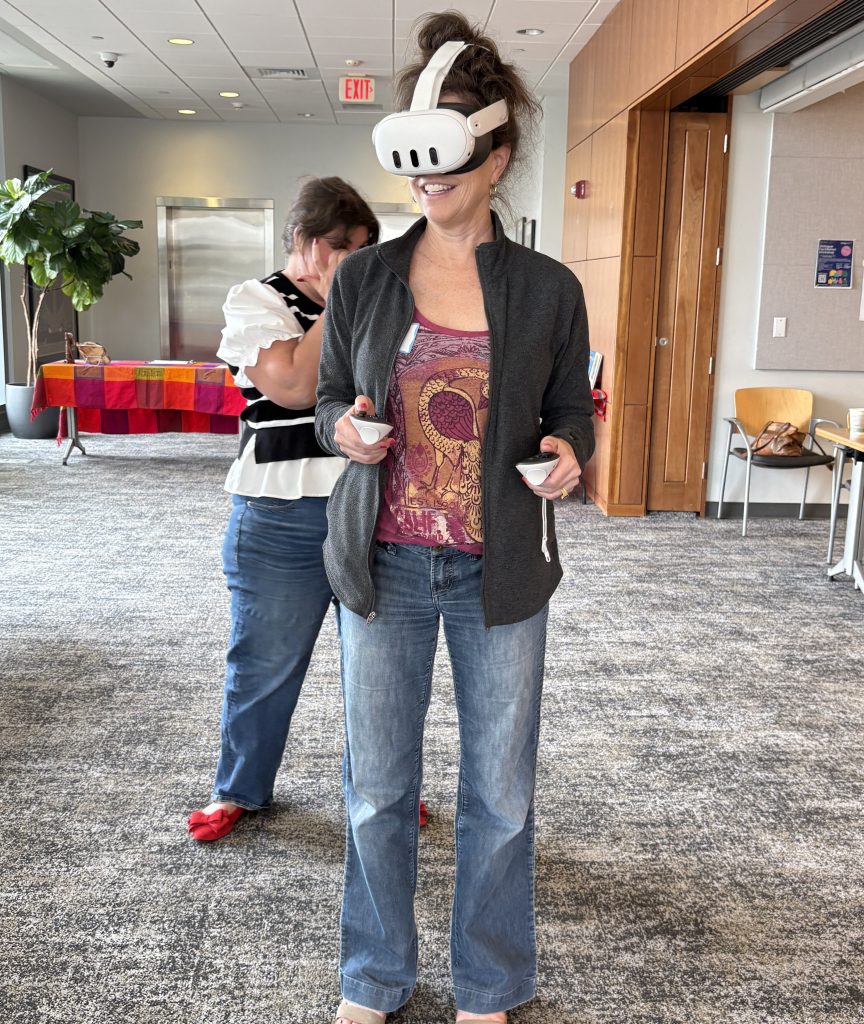
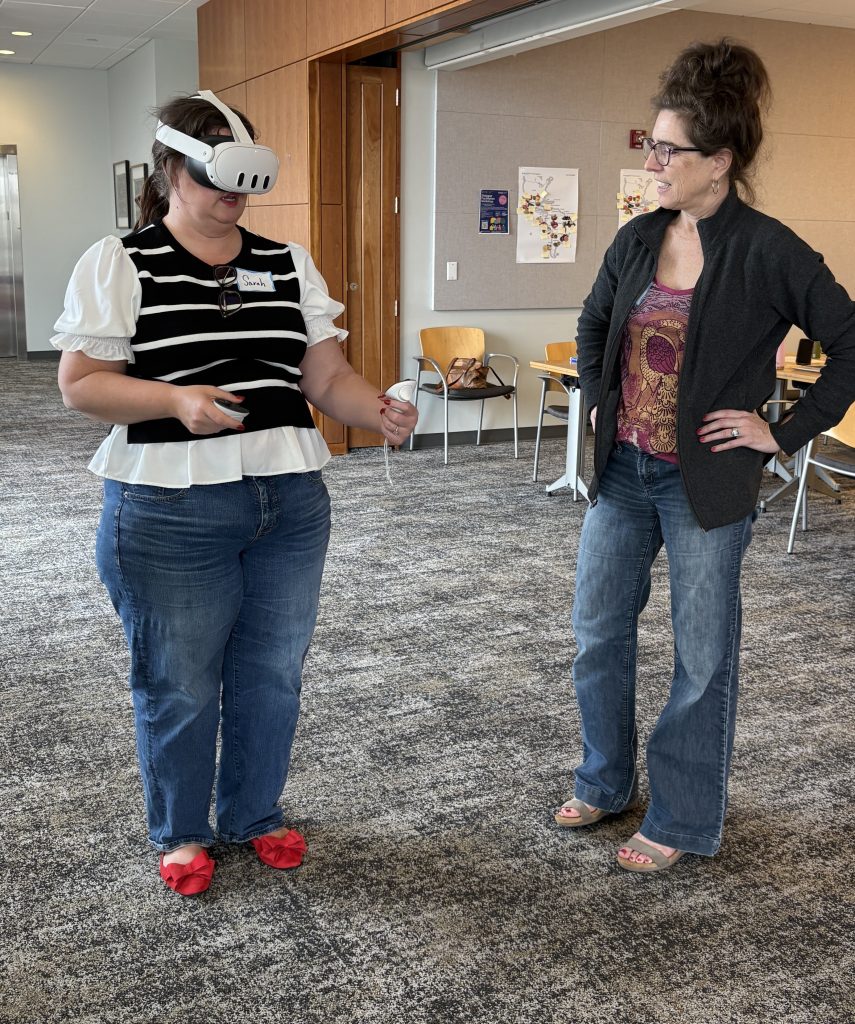
Workshop participants receive guidance on how to use VR and AR tools before beginning the immersive activities.
In a second phase, participants created their own 3D models using artificial Intelligence (AI) assisted tools. These models were then visualized through Xtended Reality (XR) technologies, including augmented reality, allowing participants to see and interact with their creations in physical space. This combination of Virtual Reality (VR), AI-generated content, and Augmented Reality (AR) visualization provided a concrete example of how emerging technologies can be integrated into classroom practice in ways that go beyond novelty and toward intentional learning design.
Throughout the workshop, emphasis was placed on helping participants think critically about how these tools might translate into their own teaching contexts. In a structured reflection activity, attendees worked through key dimensions of implementation, including pedagogical, technical, logistical, and ethical considerations. Discussions addressed questions such as access to devices, school policies on artificial intelligence, student age and readiness, and communication with families. Participants also reflected on which student populations might benefit most from these approaches, and where potential challenges or limitations might arise.
These conversations highlighted an important shift from experiencing technology as users to evaluating it as educators. Rather than focusing solely on engagement, participants considered what kinds of learning these tools make possible, and under what conditions they can be implemented responsibly and effectively.
The workshop concluded with a collective synthesis, where participants shared ideas, concerns, and potential adaptations for their own classrooms. Many noted the value of connecting STEM learning with cultural relevance, and of using immersive technologies to create more interactive and inclusive learning environments.
Materials from the workshop, including activity guides and examples of immersive environments, will be made available through the Consortium’s outreach resources.